
A dealership owner once told me he was about to fire his sales rep. He kept refusing to do the follow-up calls, and he’d already given him two warnings. From his perspective, it was a straightforward performance issue.
When I asked a few questions, the real problem surfaced quickly. The dealer was cheap and did not have enough phone lines to do the outbound calls. I observed as there was a high percentage of the time when there where no outbound phone lines available. At that time landlines were more expensive and the dealer did not want to ad another line. As a result the he could not plan or structure his day to make any follow-up calls-the system was set up to fail.
He was ready to let go of a competent employee over a problem he didn’t create and couldn’t solve.
He thought he had a people problem. He had a system problem.
This happens more often than you’d think. 70% of leaders admit they fail at strategy execution, but here’s the thing—it’s easy to jump to solutions before you’ve diagnosed the real problem. When someone tells you “we have an execution problem,” they’re often describing a symptom, not the disease.
The Three-Part Diagnostic
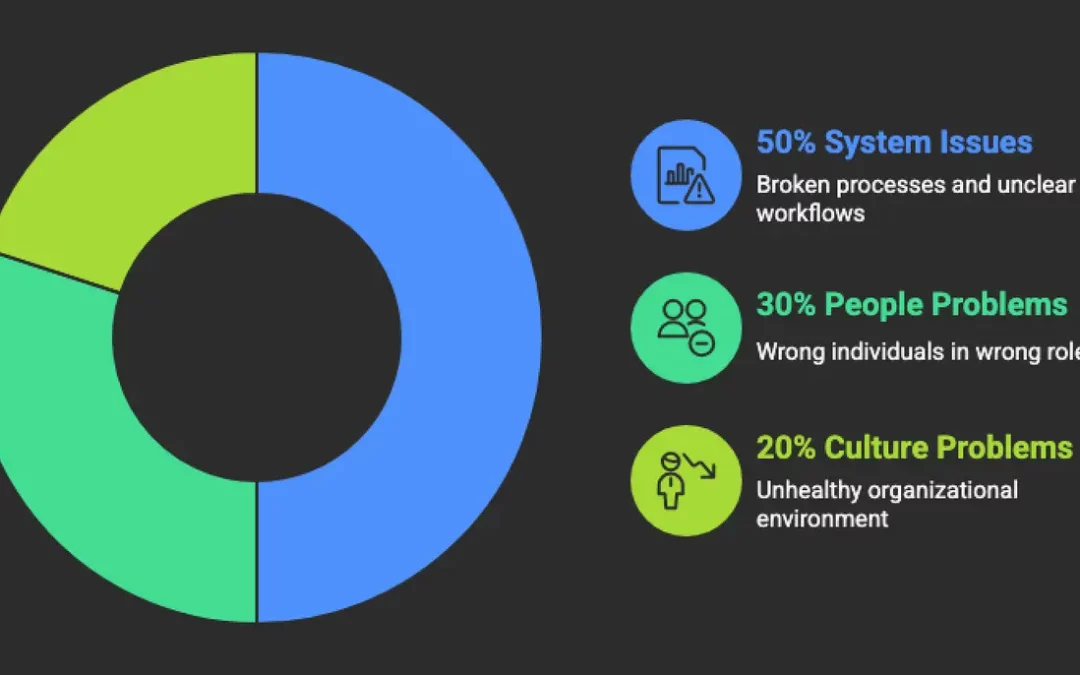
In my 36 years working with organizations across 30 countries, I’ve seen execution break down in three distinct categories: people, systems, and culture.
And here’s what I’ve learned—many leaders jump straight to “we need better people” without pausing to ask the diagnostic questions first.
People Problems: Do you have the wrong individuals in the wrong roles? Listen, I’ve seen incredibly talented teams fail spectacularly because they were placed in positions that contradicted their natural strengths. The top sales rep promoted to sale manager but can’t inspire or lead others. That’s not a performance problem—that’s misalignment. It’s nearly impossible for someone to thrive when they’re working against their wiring.
System Problems: Dr. Deming proved that 94% of performance variations have nothing to do with the workers. Think about that for a moment. When I investigate “execution failures,” I almost always find broken processes, unclear workflows, or technology that’s creating barriers instead of removing them. The people aren’t the problem—the infrastructure is.
Culture Problems: I was witness to new lead Pastor who nearly destroyed 15 years of healthy culture in just 90 days. Yes, ninety days. Research shows that within six months, poor leadership can devastate organizational culture. The execution problem wasn’t the team’s capability—it was an environment that made execution impossible. You can have the best people and the best systems, but if your culture isn’t healthy, execution becomes extremely difficult.
The Silo Story
I had a client tell me their marketing and sales teams “just wouldn’t execute” on the new strategy.
One conversation. That’s all it took to discover the real issue. Marketing was being measured on lead volume while sales was being measured on deal quality. You had talented people working against each other because the system rewarded conflicting behaviors. Who designed that?
Patrick Lencioni nailed it when he said, “Silos devastate organizations. They waste resources, kill productivity, and jeopardize the achievement of goals.”
The fix wasn’t training. It was alignment.
Ask Before You Act
So before you declare an execution problem, I encourage you to run this diagnostic:
For People Issues:
- Are your people operating in their natural strengths?
- Do they actually have the skills required for what you’re asking?
- Is there genuine capability missing, or is this just misalignment?
For System Issues:
- What processes are creating bottlenecks right now?
- Are you rewarding conflicting priorities?
- Does your infrastructure support execution or sabotage it?
For Culture Issues:
- Do your people feel safe taking initiative?
- Is there real clarity on what actually matters?
- Are you and your leaders modeling the behavior you expect?
The Real Intervention
That dealership owner? Once we fixed the phone system, his “problem employee” became one of his best performers. Same person. Different system.
The church that lost its culture? It took three years to rebuild what was destroyed in 90 days. Three years.
The siloed organization? They restructured incentives and saw execution improve within one quarter. One quarter.
Different problems require different solutions. You won’t train your way out of a system problem. You won’t restructure your way out of a people problem. And you won’t hire your way out of a culture problem.
The diagnostic comes first. Every time.
So when someone tells you “we have an execution problem,” pause. I’d encourage you to respond with: “Let’s figure out what kind.”